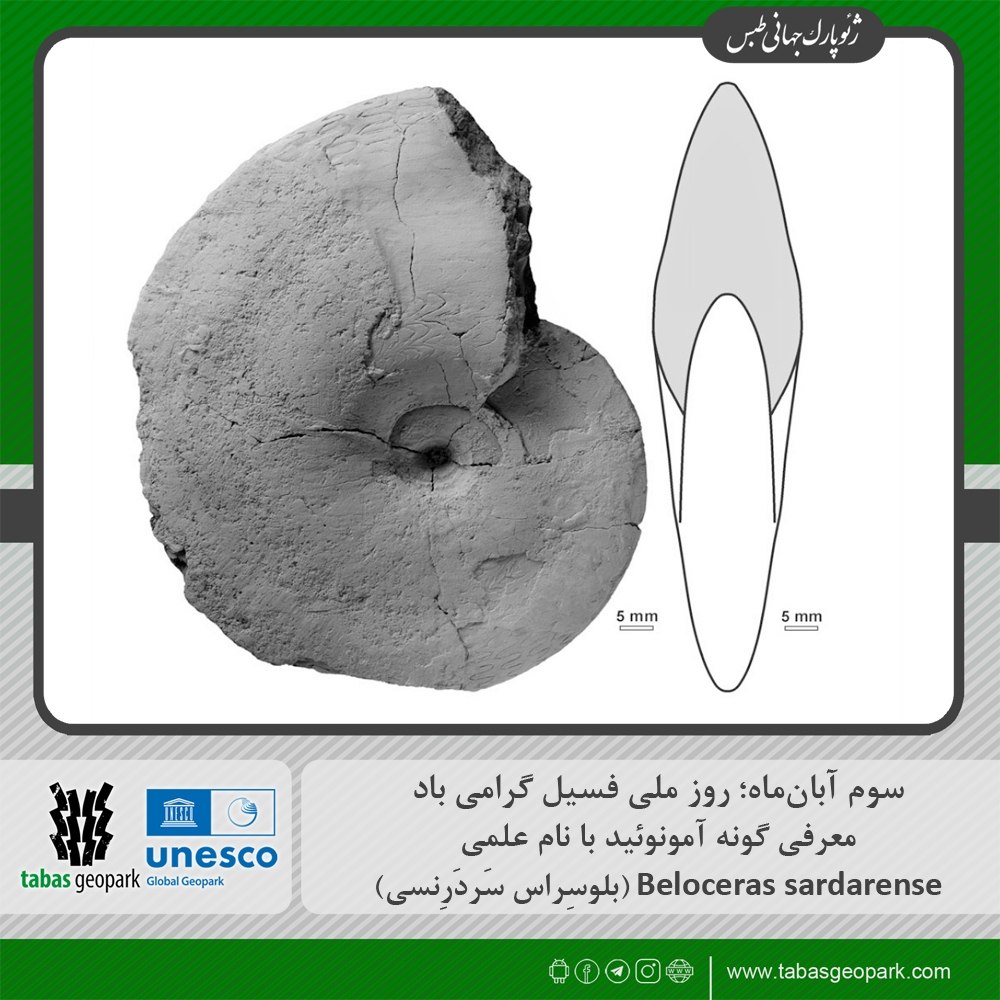


✅ Introducing a Remarkable Fossil Species from the Region on October 25, Iran’s National Fossil Day
🔷 Beloceras sardarense: A Late Devonian ammonoid from Tabas UNESCO Global Geopark
Beloceras sardarense is an ammonoid species identified in the Late Devonian rocks of the Tabas region, dating back approximately 372–382 million years. In 2011, it was introduced to the international scientific community as a new species from Tabas UNESCO Global Geopark.
🔹 The species was discovered by Dr. Vachik Hairapetian, a faculty member at Islamic Azad University, Khorasgan Branch, and Dr. Dieter Korn, a researcher at the Museum für Naturkunde and Humboldt University of Berlin. Their findings were published in the international scientific journal Bulletin of Geosciences.
🔹 The specific name sardarense was chosen in honour of Kal-e Sardar Geosite, located east of Tabas. This discovery highlights the significant potential of Tabas UNESCO Global Geopark for palaeontological research and the study of Earth’s history.
🔹 Ammonoids were marine molluscs and distant relatives of modern cephalopods, such as octopuses and squids. They possessed complex shells and lived in the seas of the Palaeozoic Era. Today, their fossil remains provide valuable information about past biodiversity, ancient marine environments, and geological evolution.
🔹 The significance of Beloceras sardarense extends beyond its great age. Its recognition as a new species was based on a scientific examination of shell characteristics and suture lines—the intricate patterns formed where the internal walls of the shell meet its outer wall. These features are essential for identifying and distinguishing ammonoid species. By comparing the specimen with other species of the genus Beloceras, researchers identified its distinctive characteristics and investigated its taxonomic and evolutionary relationships.
🔹 This research also contributes to our understanding of the geographical distribution of Late Devonian ammonoids. Studying Beloceras species from different parts of the world helps researchers better understand biological connections between ancient marine regions and the distribution patterns of organisms across palaeogeographic areas at low latitudes.
🔹 National Fossil Day provides an opportunity to raise public awareness of the importance of fossils and palaeontology. Fossils are more than the preserved remains of ancient organisms; they are natural archives of the history of life and Earth. Through their careful study, scientists can reconstruct biological changes, depositional environments, the relative ages of geological strata, and past geographical configurations.
🔹 The identification and scientific description of species such as Beloceras sardarense also highlight the importance of scientific research in fossil-rich areas. Documenting these discoveries, increasing public awareness of geological heritage, and protecting fossil-bearing outcrops help create opportunities for specialised research, geological education, and the development of scientific tourism.
🔹 With its outstanding geological and palaeontological heritage, Tabas UNESCO Global Geopark offers valuable opportunities to study Earth’s history and share this heritage with the scientific community and the wider public.
Celebrating National Fossil Day reminds us of our shared responsibility to understand and protect these irreplaceable records of Earth’s past and to preserve their scientific and educational value for future generations.